
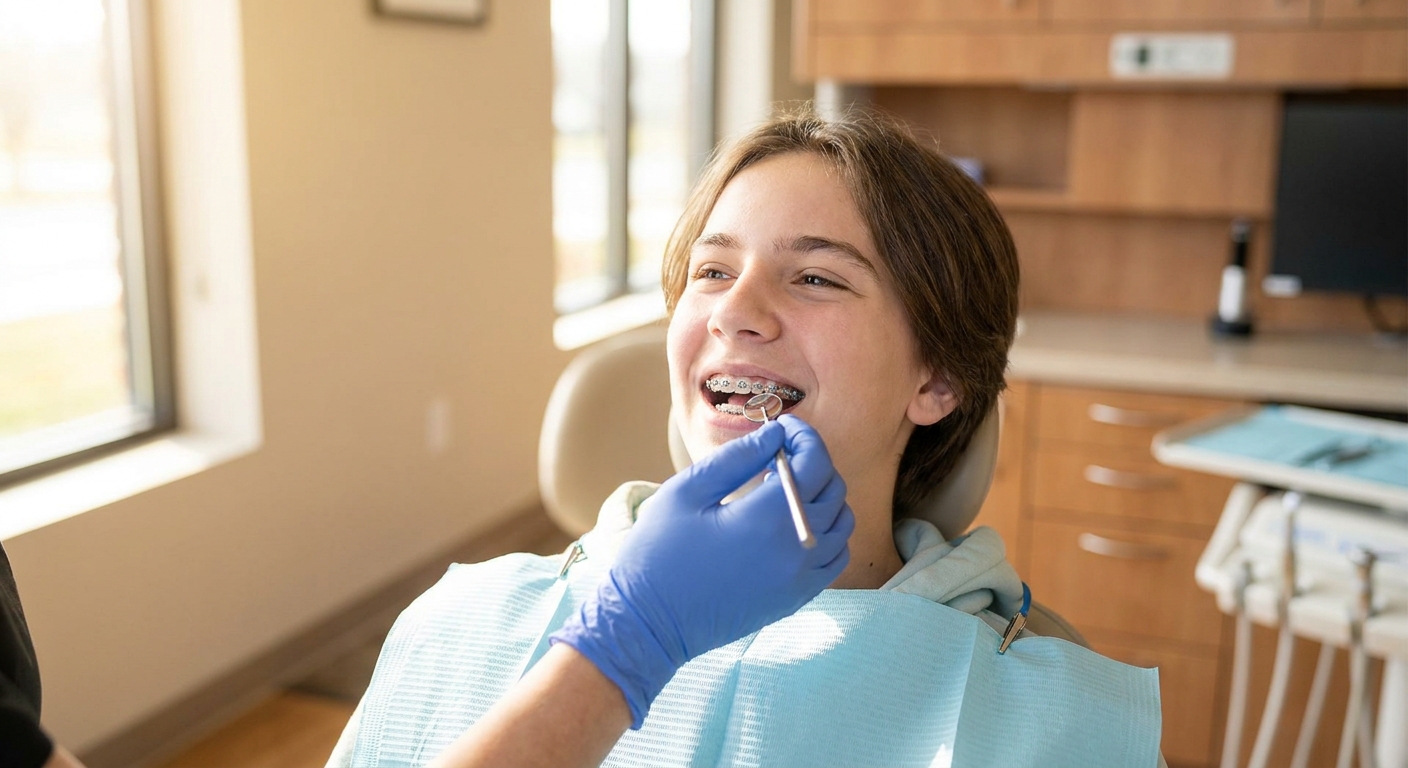
You have seen the after photos: the ads, the social media posts, the classmate who just got her braces off and will not stop smiling. Now it is your child’s turn. Before you commit to months of appointments and a real financial investment at Wright Orthodontics, you want an honest answer.
This guide explains how braces move teeth, the types of braces available, what an orthodontist means by “straight,” what braces cost in Mesa, how to pay for them, why your child’s daily habits matter, how to keep the result, and which age may be considered for starting treatment.
How do braces straighten teeth, and what keeps them from perfect?
Braces may straighten teeth with gentle, steady pressure. That pressure slowly reshapes the bone around each root so the tooth can move. The process is reliable in many cases, but bone density, root shape, jaw size, and the natural shape of each tooth limit where every tooth can safely go.
A traditional setup has three parts. Brackets attach to the front of each tooth. An archwire runs through the brackets and guides the teeth toward their planned positions. Small rubber bands, called elastics, sometimes link the upper and lower teeth to help correct the bite. The FDA explains that braces move teeth by applying pressure over time. That is the key idea: braces are slow on purpose. Under pressure, the bone on one side of a root breaks down a little, and new bone fills in on the other side. Repeat that over many months, and the tooth travels.
That same biology is where the limits come from. A root has to stay surrounded by healthy bone. If a tooth is pushed too far toward the cheek or tongue, the bone and gum covering it can thin out. A jaw that is small for the size of the teeth may not have room for every crowded tooth to line up without a plan to create space. And sometimes one tooth is naturally narrower than its partner on the other side, so the two will never look like exact mirror images, even when both sit in the right spot.
This is why the evaluation comes first. Wright Orthodontics offers same-day treatment start options at its Mesa and San Tan Valley area offices. Once your child’s teeth, bite, and jaws have been examined and the personalized plan makes sense to you, your child may be able to begin at that same visit. You skip the waiting and still start with goals built around your child’s own anatomy.
What types of braces are available?
Knowing how braces work makes it easier to compare your options. Wright Orthodontics offers three main choices, and the right one depends on your child’s bite, age, and comfort level:
- Traditional metal braces: Stainless steel brackets and wires. They are durable, may help address complex bite problems and malocclusion, and kids can pick fun colored bands at each visit.
- Clear braces: These work like metal braces but use tooth-colored or clear brackets that blend in. Many teens and adults like them because they are less noticeable.
- Clear aligners: A series of removable, nearly invisible trays that shift teeth in small steps. They can work for some cases, but they only move teeth when they are worn, usually 20 to 22 hours a day, so they suit patients who will keep them in.
At your orthodontic consultation, the Wright Orthodontics team can explain which options may fit your child’s case and why.
What does “straight” actually mean to an orthodontist?
Whichever type you choose, the goal is the same. To an orthodontist, “straight” means three things together: teeth lined up neatly, upper and lower teeth that fit together in a healthy bite, and a result that can stay put for years. It does not mean flawless symmetry, because the healthiest result is sometimes a hair short of picture-perfect.
MedlinePlus describes orthodontia as the branch of dentistry focused on correcting teeth and jaws that are out of position. Note the word jaws. A smile can look straight from the front and still have a bite where the back teeth do not meet well. That kind of bite can wear teeth down unevenly or strain the jaw. So when an orthodontist plans your child’s treatment, the front-view appearance is one goal among several. The six concerns Wright Orthodontics treats, misaligned teeth, crooked teeth, crowded teeth, gaps between teeth, bite problems, and malocclusion, each affect more than looks.
Sometimes those goals compete. Here is a common scenario. Your child has a gap between two front teeth and a slight overbite. Closing the gap completely might push the bite into a less stable position. In a case like that, the plan may leave a tiny space that a family dentist can later close with bonding, or it may adjust tooth positions to protect the bite. Neither choice is a failure. Each one weighs appearance against function and stability.
The time to understand these trade-offs is before treatment, not on the day the braces come off. Wright Orthodontics creates personalized treatment plans during orthodontic consultations. That is your chance to ask, “What will be different when this is done, and is there anything we might decide to leave alone?” A clear answer may help keep the end result from surprising you.
What are the benefits of braces?
Even if braces do not make every tooth a perfect mirror image, the payoff can be real for some patients. Here is what families may gain:
- An improved smile: Some families tell us at Wright Orthodontics their kids seem to smile more freely in photos, at school, and with friends after crowded teeth and gaps are addressed, though every child is different and results vary by individual case and cannot be guaranteed.
- A healthier bite: Orthodontic treatment aims to create a bite where teeth meet properly, which can help distribute bite forces more evenly.
- Easier cleaning: Orthodontists often note that aligned teeth may have fewer tight corners where plaque can hide, which may make brushing and flossing simpler, though individual oral hygiene results depend on each patient’s daily habits.
- Reduced risk of chipped teeth: Front teeth that stick out are more likely to get hit during sports and play.
- More comfortable chewing and speaking: Some bite corrections address functional issues, and some patients find eating and certain sounds easier afterward, though whether chewing or speech improves depends on the specific bite problem and each individual case..
- Long-term stability potential: A well-planned result is supported by a retainer, which helps maintain orthodontic results, though how long results last depends on retainer wear, individual biology, and natural age-related tooth movement.
How much do braces cost in Mesa, AZ?
Braces in Mesa commonly cost somewhere between about $3,000 and $7,000 before insurance, depending on the type of braces and how complex your child’s case is. The only way to know your child’s exact cost is a consultation at Wright Orthodontics, where the plan and the price are laid out together.
Several factors shape the number. Traditional metal braces are often the most budget-friendly choice, while clear braces and clear aligners can cost more. Severe crowding or a bite problem that needs extra steps usually means a longer treatment time and a higher fee. Your insurance coverage changes the out-of-pocket total too.
You may be worried about hidden fees or a bill that grows halfway through treatment. That is a fair worry, and it is worth raising directly. Ask the Wright Orthodontics team what the quoted price includes, such as adjustment visits, emergency repairs, and retainers, so you can compare the full picture rather than just the starting number.
Can you pay monthly for braces?
Yes, many families spread the cost of braces over time instead of paying it all at once, and it is worth asking Wright Orthodontics about the payment options available for your plan. A monthly arrangement can make treatment fit a family budget without delaying your child’s start.
Insurance can lower what you owe each month. Wright Orthodontics accepts five payment routes: Blue Cross Blue Shield, Cigna, Humana, MetLife, and cash pay. Many dental plans include an orthodontic benefit with a lifetime maximum, and the team can help you understand what your plan is likely to contribute before treatment begins. If your family has a health savings account or flexible spending account, you may also be able to use those pre-tax dollars for orthodontic care. Getting these answers up front means the number you plan for is the number you pay.
Why does your child’s follow-through decide the final result?
Once the plan and payments are set, the next big factor is what happens at home. Braces only move teeth while they are doing their job. Rubber bands left in a backpack, missed adjustment visits, and broken brackets can slow treatment and may keep teeth from reaching their planned spots. Two kids with nearly identical plans can finish with different results because of daily habits alone.
Elastics are a significant factor. The archwire lines up teeth within each jaw, but rubber bands help correct how the two jaws meet. Say your teen wears them on Monday, skips Tuesday and Wednesday, and catches up on Thursday. The teeth spend part of the week moving forward and part of it settling back. That stop-and-start pattern can drag out treatment and may leave the bite short of its target.
Adjustment visits matter for a similar reason. At each one, the orthodontist checks progress and updates the wire so the pressure keeps doing useful work. When a visit gets pushed back, the wire holds the teeth where they are, but it does not move them toward the next stage. A popped bracket works the same way: until it is fixed, that tooth can drift. Hard, sticky, and chewy foods are the usual culprits.
You may be worried you will turn into the household rubber band police. Most parents feel that way. A few habits help. Keep a bag of elastics in your teen’s backpack, in the car, and by the bathroom sink. Tie band changes to things that already happen every day, like brushing after breakfast and before bed. Ask the team to explain to your child, not just to you, why the bands matter, because kids follow through better when they understand the reason. The welcoming staff at Wright Orthodontics talks to your teen like a partner, which can make that conversation easier than any lecture at home. Careful brushing around the brackets matters too, since plaque that sits there can leave chalky white marks on the enamel after the braces come off.
Will your child’s teeth stay straight after braces come off?
Teeth may stay straight after braces as long as retainers are worn as directed. Without a retainer, teeth naturally drift back toward their old positions. This drift is most noticeable soon after the braces come off, but it continues in small ways for life.
The reason is biology, not poor treatment. The bone around newly moved teeth needs time to firm up, and the elastic fibers that connect teeth to the gums tend to pull back toward where they started. On top of that, everyone’s teeth shift slowly with age. Health information published through the NIH’s bookshelf notes that teeth can move back after braces treatment, which is why retainers are used to help hold the result in place.
For a parent, this changes how you think about the investment. The day the braces come off is not the finish line. It is the start of the phase that helps protect what you paid for. Picture two teens who get their braces off the same week. One wears a retainer every night as told. The other wears it for a month, then leaves it in a drawer. A year later, the first teen’s smile may look much like it did on that last day. The second teen may notice a front tooth starting to turn or a small gap coming back.
Retention planning is part of comprehensive family care at Wright Orthodontics. At your consultation, ask how long the retainer should be worn full-time, when it can switch to nighttime only, and how follow-up visits work after active treatment ends. Knowing the plan ahead of time makes it much easier to hold your teen to it.
What age may be considered for braces?
Some kids get braces between about ages 9 and 14, once most of their permanent teeth have come in and while their jaws are still growing. Orthodontists generally suggest a first check around age 7, so any problems can be spotted early, even if treatment does not start until later.
Braces can work at any age, but preteens and teens may have an advantage because their bone can respond readily to pressure. For a growing child, the orthodontist may be able to work with growth instead of against it. Some bite problems tied to how the jaws develop may be easier to guide while growth is still happening. Teens also tend to have fewer complications, such as crowns and bridges, and they usually have healthy gums. That combination is why the preteen and teen years are such a common time to start children’s orthodontics, and why it may be helpful to have your child evaluated rather than waiting to see if crowding fixes itself.
Adults are a different case. Harvard Health points out that braces are not just for teens and that adults can benefit. It also notes that adult bone is no longer growing, which can make treatment take longer, and that gum health becomes an important factor. Wright Orthodontics provides adult orthodontics with plans adapted to mature bone and existing dental work, focused on improvements that may be achievable for each patient rather than textbook alignment that may not be realistic for an adult mouth.
This matters for your family because many parents sit in the consultation chair and start wondering about their own smile. With comprehensive family care across all three Wright Orthodontics locations, the same practice can treat your teen and you. If you are curious about a more discreet option for yourself, you can read about clear braces for adults with Cigna dental.
Do braces make teeth 100% straight? Answers to what parents ask next
Braces may make some teeth very straight, and the details of your child’s case shape the exact result. These are the follow-up questions parents most often ask once they understand that.
Can braces fix severely crooked teeth completely?
Braces may help correct some severe crowding and misalignment. The final result depends on bone structure, root shape, and whether the plan needs to create extra room. In some crowded cases, that can mean coordinating with your family dentist to remove a tooth. Your orthodontist will explain the options for your child’s case.
How long do teeth stay straight after braces?
Teeth may stay straight as long as retainers are worn as prescribed. Without a retainer, teeth tend to shift back toward their original positions, especially in the first stretch after braces come off.
Will braces hurt my child?
Some kids feel some soreness for a few days after braces go on and after adjustments. Soft foods and over-the-counter pain relief, used as directed, may help. The discomfort is generally mild and short-lived.
What happens if you don’t wear your rubber bands during braces treatment?
Skipping elastics can slow tooth movement, can lengthen treatment, and may keep the bite from reaching its planned position. Wearing them consistently gives the plan its best chance to work as designed for that individual.
Do braces work better for kids or adults?
Braces can work for both. A child’s growing jaw may make some corrections easier and sometimes reduces the need for more involved steps. Adult treatment often takes longer and may be limited by mature bone and existing dental work.
Why do some teeth look slightly uneven even after braces?
Slight differences can come from natural tooth shape and size, differences in bone, or a deliberate choice to protect the bite and long-term stability rather than chase a cosmetic detail that might not hold.
How does Wright Orthodontics set realistic expectations before treatment?
During an orthodontic consultation, the team examines your child’s teeth, bite, and jaws, then builds a personalized treatment plan and talks through specific goals, costs, and any likely limits. You can also ask to see before-and-after photos from other patients so you have a real-world picture of what treatment may achieve.
Find out what “straight” will look like for your child
The way to know what braces might do for your child is a consultation that looks at their actual teeth, bite, and jaws. Every smile starts from a different place, so a personalized plan answers the question better than any photo online.
Wright Orthodontics serves families from three locations across Mesa and San Tan Valley. Families come for the trusted expertise, the welcoming staff, and a memorable patient experience that may help anxious kids feel at ease because the team explains each step in words your child understands. With same-day treatment start options, you will not have to wait weeks between deciding and getting started.
Schedule an orthodontic consultation at Wright Orthodontics in Mesa or San Tan Valley to see your child’s personalized treatment plan, review realistic alignment goals for their unique anatomy, get a clear cost breakdown with your Blue Cross Blue Shield, Cigna, Humana, or MetLife coverage, and understand what braces may be able to deliver for their case.
One tip before you go: bring this question to the consultation, word for word: “What will my child’s teeth look like at the end, and what, if anything, will we choose not to change?” The answer tells you more about the result you might expect than any before-and-after photo.
Ready to Learn What Braces Can Do for Your Smile?
If you’re wondering whether braces can give you the straight teeth you’ve been hoping for, the best answer comes from seeing your unique situation up close. Every smile responds differently to treatment, and understanding what’s possible for you starts with a conversation. The team at Wright Orthodontics in San Tan Valley and Mesa is ready to walk you through realistic expectations and create a plan tailored to your goals.
Orthodontic results vary from patient to patient based on individual anatomy, treatment plan, and follow-through.